Direct Serial EIE
The Direct Serial EIE communication device provides RTU communication to directly connected RS-232 and RS-422 devices.
|
Direct Serial EIE Device Editor |
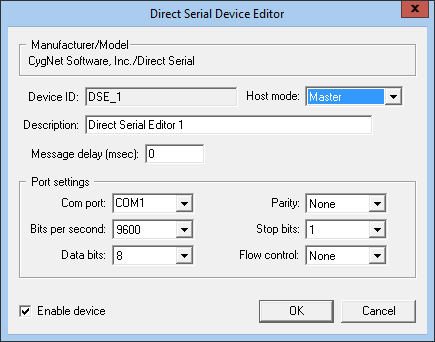
A 64-bit version of this EIE is available. See 64-bit Device Drivers.
Properties
The following table lists and describes properties from the Direct Serial Device Editor dialog box.
| Property | Description | ||||||
|---|---|---|---|---|---|---|---|
|
Device ID |
The unique identifier of an instance for this device. This free-form name must be unique in the DDS and the FAC. That is, it must be a name not used by any other communication device, import/export device, remote device, or facility. CygNet naming standards for device ID are as follows:
|
||||||
|
Description |
A free-form description of the device. 32 character maximum. |
||||||
|
Message delay (msec) |
The delay (in milliseconds) to wait before sending a message to the field device. If the field device also has a message delay, the greater value takes precedence. |
||||||
|
Host mode |
Listen This mode indicates that the communications device can only listen to a data stream from an external source. This mode is also implemented on a per remote device EIE basis. NonMaster This mode is remote device-specific. It is not designed to allow write messages to be sent to an RTU. However, because each remote device EIE specifies what a write message is, you might still be able to send some write messages. Master This default mode allows any message to be sent. |
||||||
| Port settings | |||||||
|
Com port |
The port to which the communications device is connected. You can type a port number in the box if necessary. The CygNet Universal Interface Service (UIS) takes control of the communication ports for which Comm Devices are defined and enabled. To release the port you must disable the communications device or stop the UIS. |
||||||
|
Bits per second |
COM Port bit speed. The port speed and field device speed must match. |
||||||
|
Data bits |
Number of data bits. |
||||||
|
Parity |
Parity type. |
||||||
|
Stop bits |
Number of stop bits. |
||||||
|
Flow control |
Handshake signal. |
||||||
|
Enable device |
Select whether to enable or disable the device. The default setting is disabled. If an invalid configuration is detected, the device will automatically be disabled. The device can be re-enabled after the invalid configuration is fixed. |
||||||


